
Trade Insights, 7 October 2026, 7 min read
Made in Africa, Sold by Other People
EU deforestation rules will ask where cocoa and coffee were grown. That data starts with the producer, yet the readable party in most deals is the trader in between.
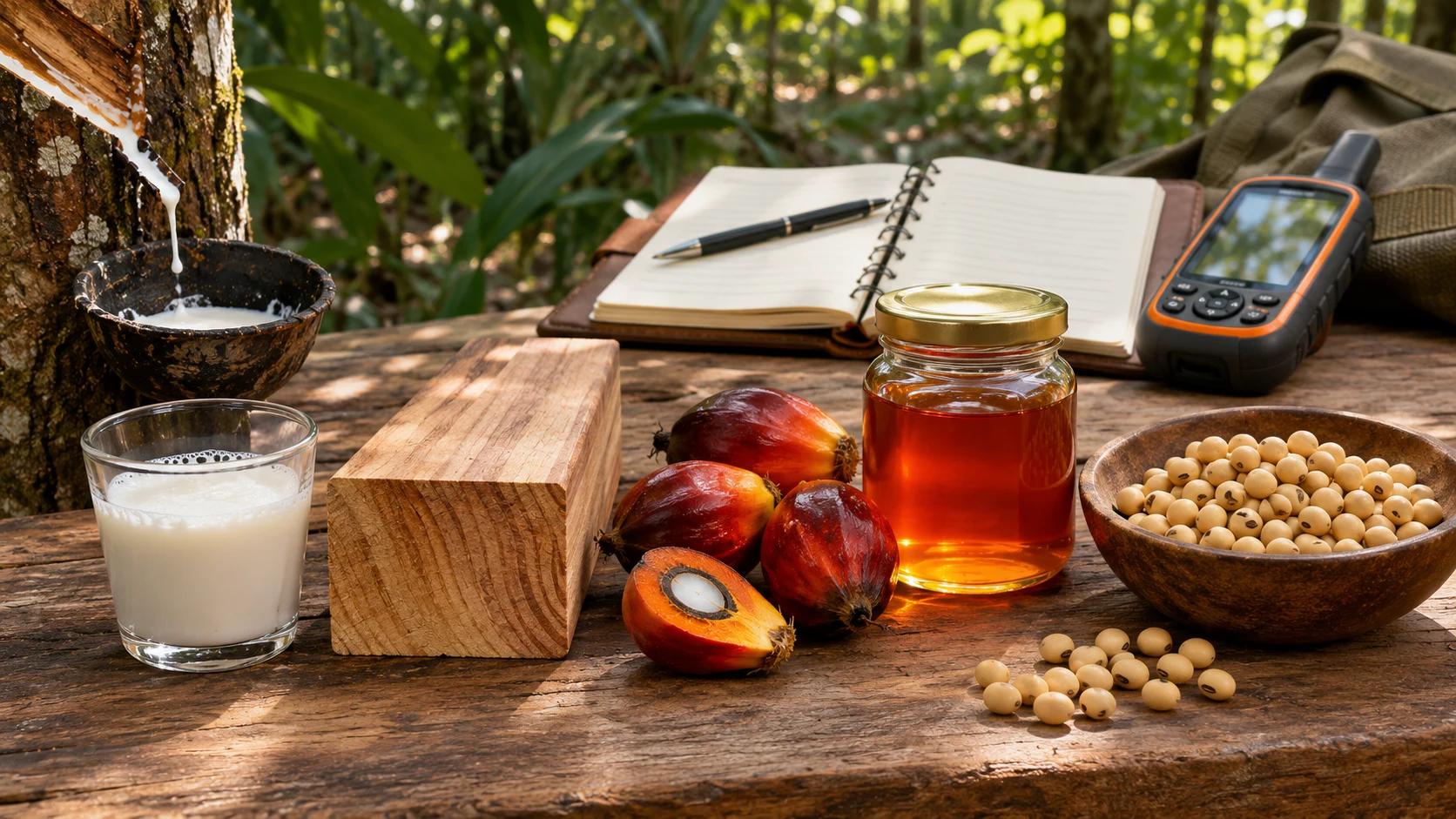
Regulation (EU) 2023/1115, the EU Deforestation Regulation, asks a simple question of every bag of cocoa or coffee sold into Europe: where exactly was this grown? Companies that place cocoa, coffee, cattle, oil palm, rubber, soya or wood products on the EU market must run due diligence showing the product is not from land deforested after 31 December 2020, was legally produced, and must file a statement that includes the geolocation of the plot of harvest. After two postponements, the European Commission says the rules apply to large and medium-sized operators and traders from 30 December 2026, and to micro and small enterprises from 30 June 2027. Timber is the exception: micro and small operators whose products were already covered by the old EU Timber Regulation still face 30 December 2026.
Read that as a producer. The European buyer is about to require information that sits with you: plot coordinates, land records, harvest dates. Whoever can hand that information to the buyer, in the buyer's format, becomes the readable party in the deal. Today that party is often not the producer. It is the trader in between.
This essay is about why, and what a producer can do before the deadline arrives.
What the buyer can and cannot see
Take an illustrative composite, not a real person: a category manager at a European retailer who needs a second supplier of shea butter. She has a few weeks and a dozen other projects.
She can find producers. Trade platforms, freight forwarders, chambers of commerce and certification registers will give her dozens of names, from women's cooperatives to industrial processors. For each, she can confirm a few things quickly: the company is registered, it has a website, and its certifications appear in the certifier's public register.
What she cannot confirm in that time is what she needs most. Is quality consistent across shipments? Is the business financially stable? Can it scale from a pilot order to a full contract? What do its past buyers say, when the references are not chosen by the producer? Can it produce the compliance file her own auditors will demand?
For a handful of established traders, she can answer all of those questions with two phone calls. Other retailers have audited them for years. Her peers can tell her how they perform. The checking has already been done, paid for by earlier buyers, and the trader offers the result to her at no extra cost.
So she buys from the trader. That decision is rational, and buyers in her position make it again and again. The producer's trust is real. Her buyers at home know her. It just cannot be read from a desk in Europe.
What the trader is paid for
An illustrative example, with made-up numbers. A cooperative sells a shipment to a trader for $180,000 and keeps a gross margin of 22%, about $40,000. The trader resells the same product to the retailer at a 41% margin. Some of the trader's margin pays for real work: warehousing, inspection, freight, financing, account management. The rest pays for something less visible: being the party the buyer can read.
The numbers in that example are invented. The structure is not, and it reaches far. UNCTAD's State of Commodity Dependence 2025 counts 95 of 143 developing economies as commodity-dependent in 2021–2023, meaning commodities made up more than 60% of their merchandise exports. A producer who sells through an intermediary is paying for a service, and the service is legibility. The intermediary charges for it because the buyer values it. The producer rarely sees the price, because it is built into a margin she never observes.
The trader is not cheating anyone. The trader is selling a solution to the buyer's checking problem. The producer can only stop paying for that solution by solving the problem herself.
Five layers between producer and buyer
The gap has more than one part. Each part is a reason the buyer finds the intermediary easier to read.
Verification
The trader's record has been checked many times by many buyers. The producer's has been checked rarely, by buyers whose findings are not shared. Every new buyer starts from zero.
Certification at small scale
Certifications cost roughly the same whether a producer ships a little or a lot. A large cooperative can spread the cost. A small processor often cannot, so it shares a certificate through a group or relies on a trader that holds one. Either way, the certificate does not travel with the producer's own name.
Working capital
When a buyer pays on credit terms after delivery, the producer has already funded inputs, harvest and processing, and waits again for payment. A trader that pays the producer sooner and carries the buyer's terms on its own balance sheet is selling credit as well as access. Where the trader can borrow more cheaply than the producer, that service is worth real money.
Logistics
A trader arrives with a forwarder, a customs broker and a warehouse that already know its volumes. A first-time direct exporter is a stranger to all of them, and negotiates as one.
Documentation
Retailers work from specific formats: purchase orders, invoices, packing lists, payment terms, Incoterms, audit responses. A producer fluent in her own market's paperwork but not the buyer's will look weaker than she is. The deforestation rules add a new document to that stack, and it is one only the producer's side can originate.
These five layers are what "market access" means in practice. Each one is a place where a producer's existing reputation fails to reach the buyer.
What the deadline changes
For cocoa and coffee, the EU rules move one piece of information to the center of the deal: the plot. The buyer's operator must be able to show where the product came from. That data starts with the producer. Our guide sets out what African exporters must prove under the EUDR, and when.
For cocoa, the producer is usually African, and the processing usually happens elsewhere. The International Cocoa Organization estimates that Africa grew 71.3% of the world's cocoa beans in the 2023/24 season but did only 22.3% of the world's grinding, the first processing step. Europe did 36.3% (ICCO Quarterly Bulletin of Cocoa Statistics, Vol. LI, No. 2).
A producer that collects its own plot data, keeps it current and can share it in the format buyers ask for is no longer only a supplier. It holds something the buyer cannot get anywhere else. A producer that leaves that work to the next link in the chain hands that link one more reason to stand between her and the buyer.
The same logic applies to products outside the regulation. Shea is not on the EU list. But a shea buyer facing auditors on labor, water and sourcing wants the same thing: a file she can read and trust without a site visit.
The claim we are willing to test
Here is a prediction, stated so it can be wrong. Among producers of comparable size and quality, those that can hand a European buyer a complete, checkable file (registration, certifications, plot data where required, and references from past buyers the producer did not choose) will win more direct contracts over the next five years than those that cannot. If direct contracts go no more often to the readable producers, the binding constraint was something else, and we will say so.
What to do this quarter
Start the file a buyer would ask for, before a buyer asks:
- A current extract from the company or cooperative registry, in the official language and a translation.
- Each certification with its number and the link to the certifier's public register entry.
- For cocoa, coffee and the other covered commodities, plot locations for your supply base, and a record of how you collected them.
- Three references from past buyers who have agreed to take a call, with their contact details and the products and volumes involved.
- A sample set of export documents in the formats your target buyers use.
Pick one buyer you would like to sell to directly. Build the file as if their auditor will read it, because one day one will. For more on how we see African producers and foreign buyers, read AfroSynergy for African businesses.
AfroSynergy connects international buyers with African exporters. Listings open on 15 January 2027. To source a product or find a counterparty now, send us an enquiry.
Ready to Explore Opportunities?
Discover funding opportunities, partnerships, and projects across Africa. Founding-cohort access is by invitation during pre-launch.
Comments
Sign in to leave a comment. Comments are moderated.
Keep reading
Sourcing from Africa?
Listings open on 15 January 2027. Tell us what you need to source and we will come back to you.
Or get new guides by email.
By subscribing you agree to our Privacy Policy. Unsubscribe anytime.