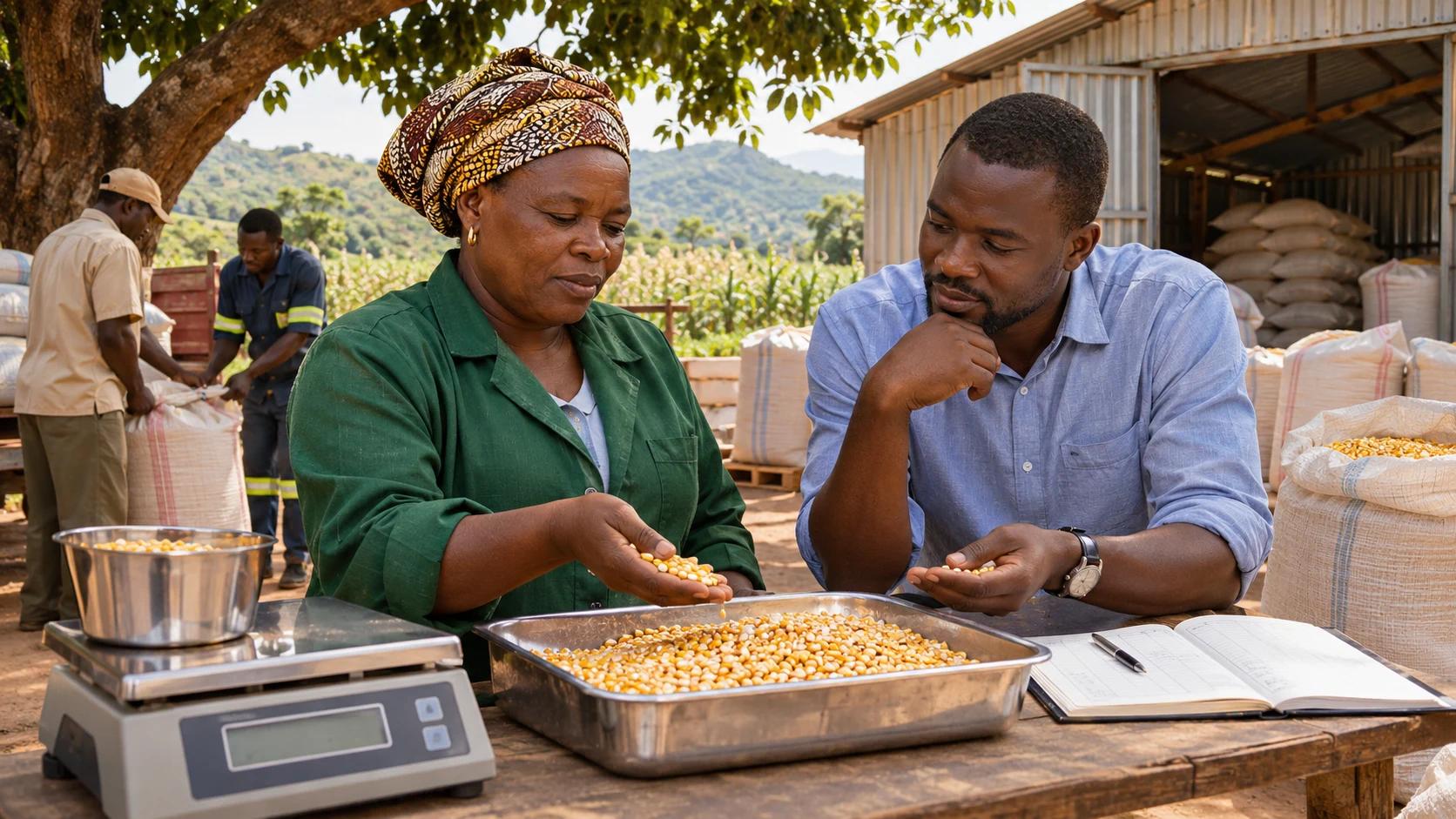
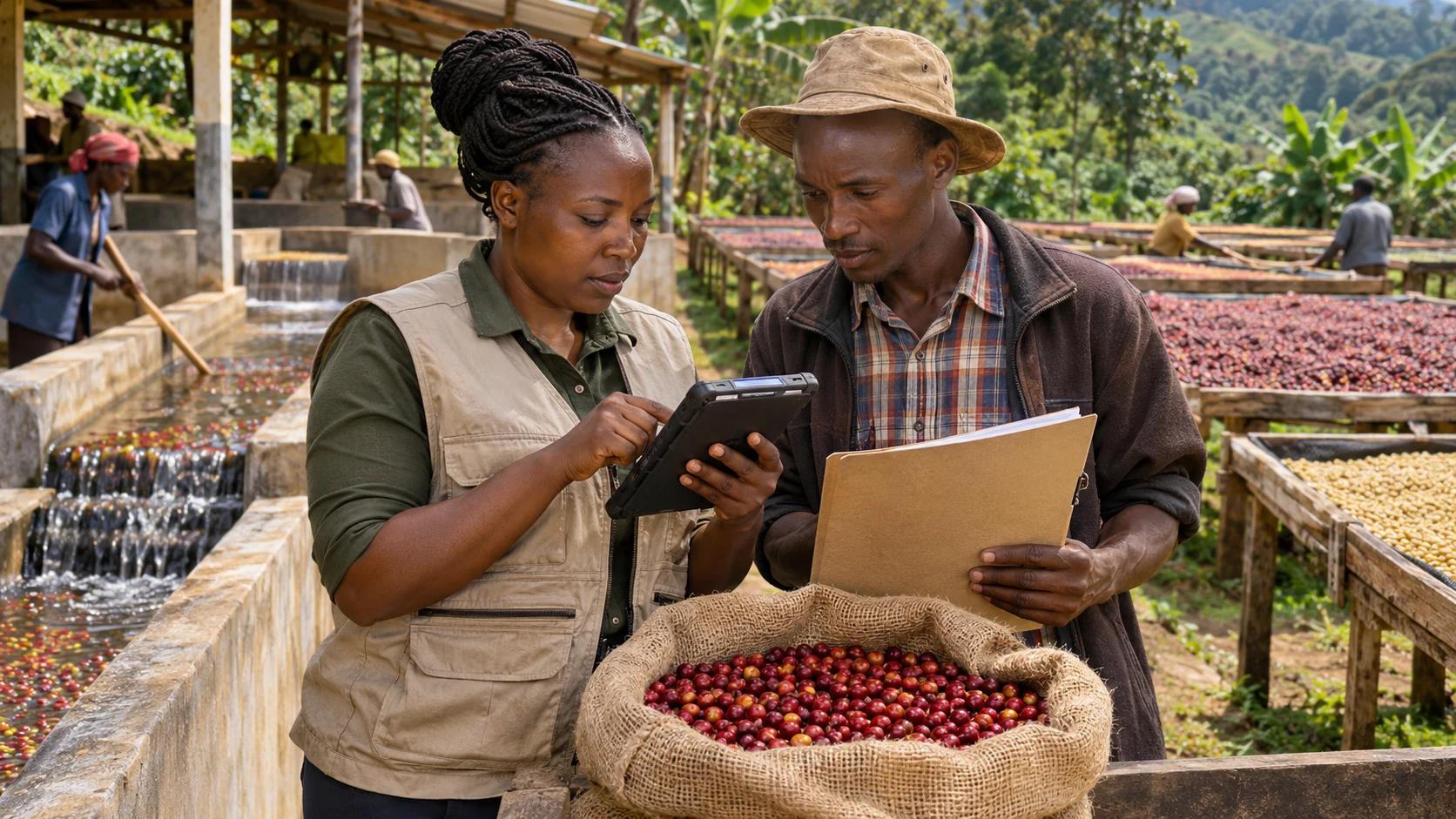
An agricultural offtake agreement is a contract in which a buyer commits to purchase a specified quantity of a crop from a producer, or a group of producers, at a future date, often before the crop is planted. The producer gets a market and, frequently, the finance to grow the crop. The buyer gets supply of a defined quality on agreed price terms, with less exposure to the spot market.
The instrument addresses two problems at once: producers who cannot pay for inputs up front, and producers who cannot reliably reach buyers who pay for quality. Done well, it anchors a value chain for years. Done badly, it ends in side-selling, disputed grades and unpaid input loans. This guide covers what the contract must contain, how pre-financing fits into it, where agreements fail, and how to build one that holds.
What an offtake agreement is, and what it is not
An offtake agreement is a forward purchase contract. The buyer commits to buy. The producer commits to supply. Both commitments bind. It is not a memorandum of understanding, a letter of intent or a statement of interest.
The buyer commits to purchase a defined quantity, meeting a defined specification, at a defined price or under a defined pricing formula, at a defined delivery point and time. Without that binding commitment there is no offtake, only an expression of interest.
The producer commits to produce and deliver that quantity, to that specification, at that time. Without it, the buyer is simply first in line on the spot market.
Vague quantities, specifications, prices or delivery terms do not make an agreement flexible. They make it a document each side will read differently when prices move.
Why offtake matters more, and is harder, in African agriculture
Smallholder supply. Much African production comes from small farms whose individual output is too small to contract with a commercial buyer directly. Most offtake agreements are therefore signed with an aggregator or cooperative that buys from many farmers. That adds a risk: the aggregator's ability to deliver depends on farmers who are not party to the contract.
Input finance. Many smallholders cannot pay for seed, fertiliser and crop protection without credit. The offtake agreement is often the channel for that credit: the buyer or a linked lender advances inputs, and repayment is deducted from the crop payment. Combining finance and purchase in one instrument is common in African contract farming and changes both the drafting and the risk.
Quality and grading. Grading practice varies by country and buyer. A contract that says "Grade A cashew" without defining moisture content, nut count per kilogram and defect tolerance creates a dispute at every delivery.
Price movement. A price agreed at planting can look very different at harvest. Contracts that ignore this give the losing side a reason to default.
Side-selling. When the spot price at harvest rises above the contract price, a competing buyer offering cash is hard to refuse. For the producer it is rational. For the buyer it wrecks the supply plan, and where inputs were advanced it turns into a debt that is hard to recover.
The agreement structure: what a workable offtake contract contains
Parties and their roles
Name each party precisely: legal name, registration number, registered address. If the producer is a cooperative or aggregator, describe its structure and state whether individual farmers have any rights or obligations under the contract.
Where there is pre-financing, name the financier, whether the buyer, a third-party lender or a development finance institution, and set out how the finance relates to the purchase commitment.
Commodity specification
This is the clause most often underspecified and most often the cause of payment disputes. Define:
Variety and grade, with reference to the named national or international grading standard that applies.
Measurable quality parameters: maximum moisture, maximum defects by weight, foreign matter tolerance, size or count standards for nuts and seeds, and any residue or flavour parameters the buyer's market requires.
How quality is assessed: who inspects (a named inspection company, the buyer's team or an agreed laboratory), where (origin, port or destination), who pays, and what happens when the two sides disagree with the result.
Every quality dispute traces back to something assumed and not written down. Writing it down costs less than the first dispute.
Quantity
State total tonnage, split by delivery tranche or season, with an agreed tolerance band around it. Then state what happens outside the band. Is a shortfall excused by named force majeure events such as drought or a defined pest outbreak? Must the buyer take excess production, or may the producer sell it elsewhere?
For season-long or multi-year contracts, say whether the commitment is a firm tonnage or a purchase right. The difference matters when prices move.
Pricing mechanism
Fixed price. One price per unit for the whole commitment. Simple to plan around, but one side loses whenever the market moves. Include an explicit acknowledgement by both parties that the price holds regardless of market movement.
Floor with shared upside. The producer gets a guaranteed minimum, and both sides share any rise above a trigger. An illustrative example, with made-up numbers: a floor of $1,200 a tonne; if the reference price at delivery exceeds $1,400, the amount above $1,200 is shared 60/40 between producer and buyer. Because the contract already captures part of a rising market, the pull toward side-selling weakens.
Index-linked price. The contract price is a premium or discount to a published reference. For cocoa, the usual reference is the London cocoa futures contract on ICE Futures Europe, which ICE describes as the global benchmark for physical cocoa pricing; the exchange took over the London International Financial Futures and Options Exchange (LIFFE) in 2013, so older contracts that cite "LIFFE" need updating. Specify the reference contract, the pricing date and the basis, in the same unit and currency as the reference.
Pre-financing terms
Document the finance as carefully as the purchase, ideally in the same agreement.
Amount and drawdown, tied to the crop calendar: land preparation, planting, mid-season inputs.
Cost of finance: an interest rate, or a cost built into the purchase price. Say which.
Repayment: usually a deduction per tonne at delivery. State the deduction, how many deliveries the repayment spans, and what happens to any balance if deliveries fall short.
Security: a lien on the crop, a guarantee from cooperative officers, or warehouse receipts if the crop is stored. Security over a standing crop is often hard to enforce, which is why the deduction-at-delivery mechanism usually carries most of the weight.
Default: what happens if the producer takes inputs and does not deliver, whether through side-selling, crop failure or anything else. Options include immediate repayment, conversion to a term loan, or a first right over the next crop. Have a lawyer confirm each remedy is enforceable under the governing law.
Delivery terms
Specify the delivery point (farm gate, aggregation centre, named warehouse, port), the Incoterms rule and edition (Incoterms 2020 is the current edition; our guide to structuring an import/export deal in Africa explains the main rules), the delivery window, how deliveries are scheduled, who provides transport and who pays for it. For perishables, set a maximum time from harvest to delivery and the storage conditions in transit.
Force majeure
Define force majeure for farming: drought by a stated rainfall measure, flood, a named pest or disease, unrest that physically blocks access. Clauses that say only "circumstances beyond the producer's control" get invoked by whichever side dislikes the price.
State plainly that force majeure excuses delivery, not repayment of finance already advanced. A producer whose crop genuinely fails still owes the input loan, even though the delivery obligation is suspended. The two obligations are separate.
Dispute resolution
Name the governing law and the forum. If you choose arbitration, name the institution and the seat. Options in the region include the Kigali International Arbitration Centre, launched in 2012; the Nairobi Centre for International Arbitration, established under an Act that came into force in January 2013; and the Regional Centre for International Commercial Arbitration in Lagos, inaugurated in 1989. In the OHADA states of West and Central Africa, the Uniform Act on Arbitration adopted in November 2017 is the general arbitration law, and the Common Court of Justice and Arbitration in Abidjan runs institutional arbitration.
The clause has to be usable. A seat with no connection to either party, under rules neither can afford to use, protects nobody.
Who provides pre-financing and how it works
The buyer. The simplest structure, common where a company contracts directly with cooperatives. The buyer invests in its own supply base. The risk is that it becomes creditor and customer at once, which complicates both recovery and the relationship when a crop fails or is side-sold.
Development finance institutions. DFIs provide credit lines and guarantees for agricultural value chains, usually through buyers or aggregators who lend on to producers. A first-loss layer or guarantee from a DFI improves a commercial lender's position and lets a buyer finance more farmers without carrying all of it on its own balance sheet.
Warehouse receipts. Where certified storage exists, a producer deposits the crop, receives a receipt that serves as a document of title, and borrows against it. Tanzania's cashew trade runs through one: by 1 November 2026, 175,000 tonnes of cashew nuts worth more than TSh 682 billion had been sold through the warehouse receipt system in the 2026/27 season, Tanzania's Daily News reported. Kenya regulates warehouse operators through a Warehouse Receipt System Council under its Warehouse Receipt System Act, 2019 and the Warehouse Receipt System Regulations, 2021. Where a regulated system exists, the buyer does not have to be the lender.
Mobile money. M-Pesa, MTN Mobile Money and Airtel Money make it practical to disburse small input loans to individual farmers in a cooperative and collect repayment from crop proceeds at aggregation.
Protecting against the common failure modes
Side-selling. Start with pricing: a floor with shared upside gives the producer a reason to deliver when spot prices rise. Then add practical deterrents: release finance in tranches tied to production milestones so exposure is never large; register the agreement with the cooperative union so default carries a reputational cost; and give producers reasons to stay, such as field support, reliable inputs and prompt payment.
Quality disputes. Measurable parameters, a named assessment method and a defined procedure for disagreements.
Opportunistic force majeure. A specific definition and a clear statement that it excuses delivery but not repayment. Index-based weather insurance, which pays on measured rainfall or temperature rather than claimed losses, can fund real relief without inviting abuse. Ask insurers in the producing country what is on offer for your crop and district.
Cooperative governance. When the counterparty is a cooperative, its leadership can change, members may not be bound to it, and internal disputes can stop delivery. Review the constitution, member agreements and governance record before signing. Where possible, add covenants that require the cooperative to maintain stated governance standards for the life of the agreement.
The relationship behind the contract
A buyer that treats offtake purely as a price hedge, without investing in producers, gets less consistent quality and less reliable supply than one that treats it as a supply-chain programme.
The investments are concrete: agronomic support; certified seed and inputs at fair prices; quality training on a shared grading standard; help with weather insurance; and paying on time, at the agreed price, every time. None of it is charity. Each one lowers the buyer's risk. A producer who trusts that payment will arrive on time has less reason to sell to the trader at the gate.
Your next step: take your current or draft offtake contract and check it against the clauses above. If it lacks measurable quality parameters, a pricing mechanism for price movement, or a force majeure clause that separates delivery from repayment, fix those three before the next planting season. AfroSynergy's page for SMEs describes how the platform is meant to support producers and buyers.
AfroSynergy connects international buyers with African exporters. Listings open on 15 January 2027. To source a product or find a counterparty now, send us an enquiry.