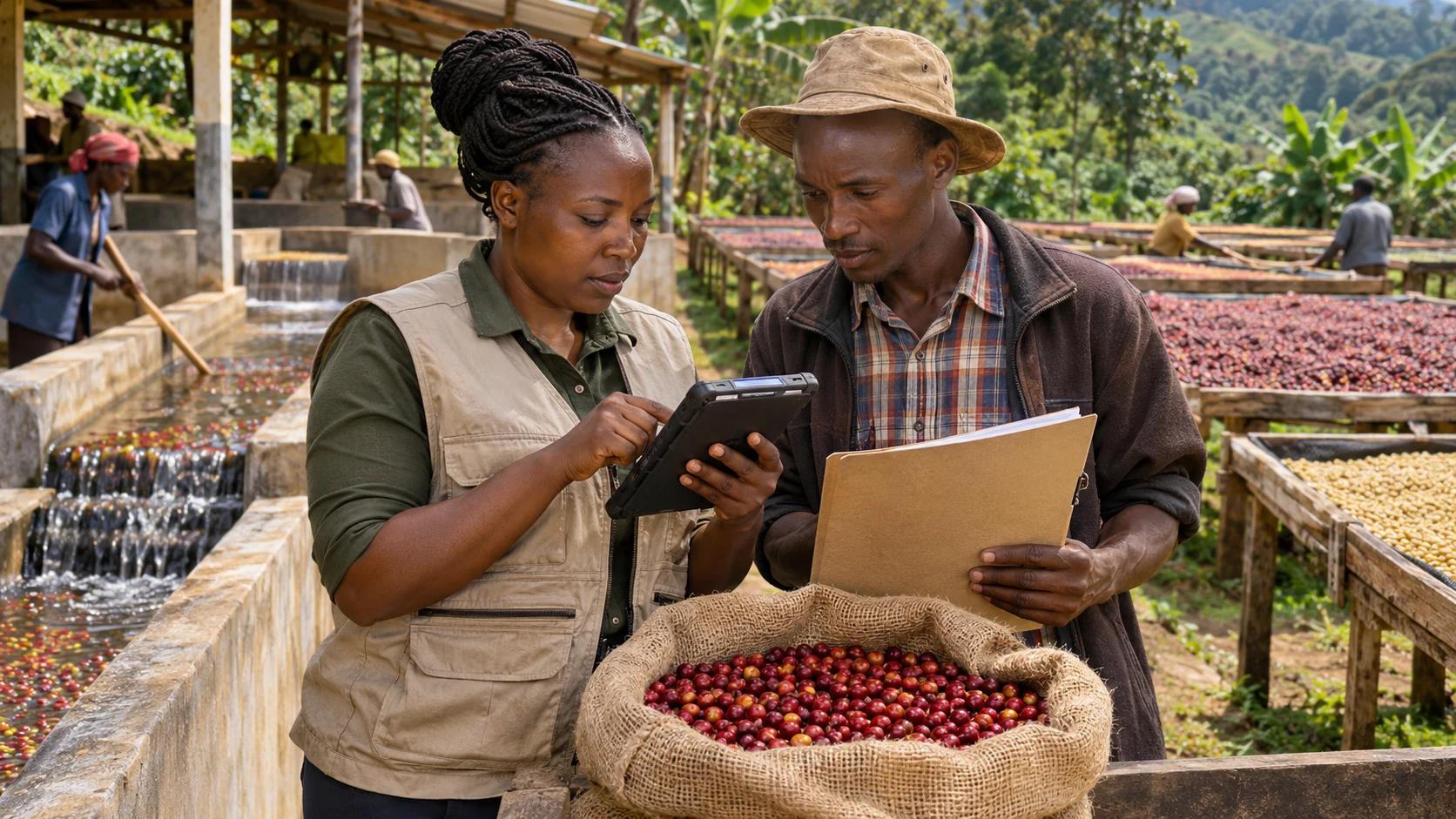
For East African coffee, the EUDR problem is aggregation. A single export lot can hold cherries from hundreds of smallholder farms, pooled at a washing station or cooperative factory, graded, and sometimes sold through an auction. The EU importer still needs the coordinates of every one of those farms, and proof none was forest after 2020. Kenya is rated low risk, Ethiopia and Uganda standard. All three now run national farmer registration or traceability systems. This guide covers what each country has built, and the records an exporter must keep so the plot list survives the washing station.
The general rules (dates, who files the due diligence statement, polygons for plots over 4 hectares, no mass balance) are in our hub guide, EUDR for African Exporters: What You Must Prove and When. This post is about coffee.
Three countries, three risk tiers of work
The EU's country benchmarking list, Implementing Regulation (EU) 2025/1093, names Kenya (and Rwanda and Burundi) as low risk. Ethiopia and Uganda are not listed, so they sit at standard risk by default.
|
Ethiopia |
Uganda |
Kenya |
| EUDR tier (checked 17 November 2026) |
Standard |
Standard |
Low |
| EU check rate on operators |
3% |
3% |
1% |
| Coffee authority |
Ethiopian Coffee and Tea Authority (ECTA) |
Ministry of Agriculture, Animal Industry and Fisheries (MAAIF), since the Uganda Coffee Development Authority was dissolved |
Agriculture and Food Authority (AFA), with county governments |
| National tool |
Ethiopian Coffee Traceability Management System (ECTMS) |
National farmer registration with unique IDs and farm geolocation |
Farmer enumeration and geomapping |
| Typical aggregation point |
Washing stations and suppliers |
Traders, hullers and cooperatives |
Cooperative factories, then auction or direct sale |
The check rates come from the EUDR as amended by Regulation (EU) 2025/2650. For a Kenyan supplier, the EU buyer collects the data but doesn't have to run a formal risk assessment. For Ethiopian and Ugandan coffee, the buyer must assess and mitigate risk, so expect more questions and tighter contract clauses.
Why coffee is harder than it looks
Coffee in East Africa is mostly not grown on cleared land. Much of it grows under trees. But the EUDR doesn't ask whether coffee is a good crop for forests. It asks whether this plot was forest at the end of 2020 and has since been converted. Shade-grown and forest coffee raises a specific risk: a satellite layer can read a shaded coffee plot as forest, or read thinning of the canopy as forest loss. In Ethiopia, according to Capital (27 September 2026), forest-coffee systems keep over 60% canopy cover and semi-forest systems 40% to 60%. Exporters in forest-coffee areas should check their plots against more than one baseline before a buyer does, and keep the evidence.
The second difficulty is the aggregation point. A washing station or cooperative factory buys cherry daily from many farmers, processes it together, and outturns lots by grade and date. Unless deliveries are logged against a farmer ID and plot, the lot's plot list is lost at the hopper.
Ethiopia: ECTA's traceability system
Ethiopia's coffee supports an estimated 20 million livelihoods and earned a record US$3 billion in 2025/26, with Europe taking about 30% of exports, per Capital. More than five million smallholders grow it, often selling through informal chains with several intermediaries.
ECTA's answer is the Ethiopian Coffee Traceability Management System (ECTMS), built with GIZ support. According to Capital's reporting, the technical handover was completed in late March 2026. The platform combines farm geolocation, supply-chain tracking and deforestation-risk tools, and a mobile app traces beans from farm through washing stations, warehouses and exporters. A later Capital report (25 October 2026) adds that it passed end-to-end testing in Shebedino woreda, Sidama, in October 2025, and that buyers in Germany, Italy, France, Belgium and Switzerland have been given data access.
Coverage is the open question. As of July 2024, about 200,000 hectares had been geolocated, roughly 23% of the 860,000 hectares targeted, per the same report. A study by ODI Global estimated that traceability gaps could affect up to 57% of the supply chain. ECTA disputes it, saying the data is out of date and that more than 99% of farms are deforestation-free. A buyer doesn't need to settle that argument. It needs to know whether its lots are covered.
For Ethiopian exporters: ask your washing stations and suppliers whether their farmers are in ECTMS, and whether the system can produce a plot list per lot you buy. If you export your own farm's coffee, you control the data yourself; if you buy from suppliers, you depend on their delivery records.
Uganda: a registration drive under a new regulator
Uganda abolished the Uganda Coffee Development Authority and moved its functions into the agriculture ministry, MAAIF, under the National Coffee (Amendment) Bill, 2024, passed in November 2024. MAAIF now leads the national registration of coffee farmers, which gives each farmer a unique ID and records farm geolocation. The stated goal was 2.8 million farmers (May 2025).
Progress reports vary by district. In October 2026, Daily Monitor quoted an agricultural officer saying more than 1.6 million farmers had been registered by August. The same report carried farmers' complaints that enumerators had registered people without their consent. Consent and data ownership matter for an exporter: a plot record a farmer disputes is weak evidence.
Registration only helps if the coffee keeps its farmer ID as it moves. Where coffee passes through traders and hullers before it reaches an exporter, every hand-off is a point where registered and unregistered coffee can mix.
For Ugandan exporters: map which of your suppliers buy directly from registered farmers, and which buy from other traders. The second group is where your lot loses its plot list. Build segregated buying for EU-bound volume, and log every intake against a farmer ID.
Kenya: low risk, but the factory and auction still need records
Kenya exports about 95% of its coffee, about 55% of it to the EU, per The Standard (30 September 2025). Mapping has been coordinated by the AFA with county governments, the Kenya Forest Service and the Kenya Agricultural and Livestock Research Organisation. The same report counted 80,211 farmers cleared across eight counties at that point, with Murang'a alone deploying 600 enumerators.
Kenyan smallholder coffee goes through cooperative factories (wet mills) and is then sold at the Nairobi Coffee Exchange or directly. In August 2023, 11 cooperative unions were licensed to sell directly, alongside marketing agents. That gives a buyer two routes, and both need records. An auction lot traced to a factory isn't enough: the factory must be able to list the farms whose cherry went into that lot.
Low risk helps. A Kenyan lot doesn't require the buyer's formal risk assessment, which makes it cheaper to buy than an equivalent lot from a standard-risk origin. Use that in negotiations, but don't let it slip into "no data needed". The geolocation requirement is unchanged.
The aggregation checklist
Whatever the country, the plot list has to survive five hand-offs.
| Hand-off |
Record to keep |
Common failure |
| Farmer to collection point |
Farmer ID, plot ID, date, weight of cherry delivered |
Cherry bought from a non-member or a passing trader, without an ID |
| Collection point to washing station or factory |
Delivery log linking each batch to its farmer IDs |
Batches from several collection points merged without the log |
| Processing (pulping, fermenting, drying) |
Which day's intake went into which drying table or bin |
Days mixed on the drying tables, so the lot has no clear intake list |
| Dry mill and grading |
Outturn record linking each graded lot back to its parchment lots |
Regrading blends parchment from several stations |
| Auction, direct sale and export |
Data pack per lot: plot list in GeoJSON, production dates, forest-check result, legality documents |
Data sent after the coffee ships, or a factory-level reference with no farm list |
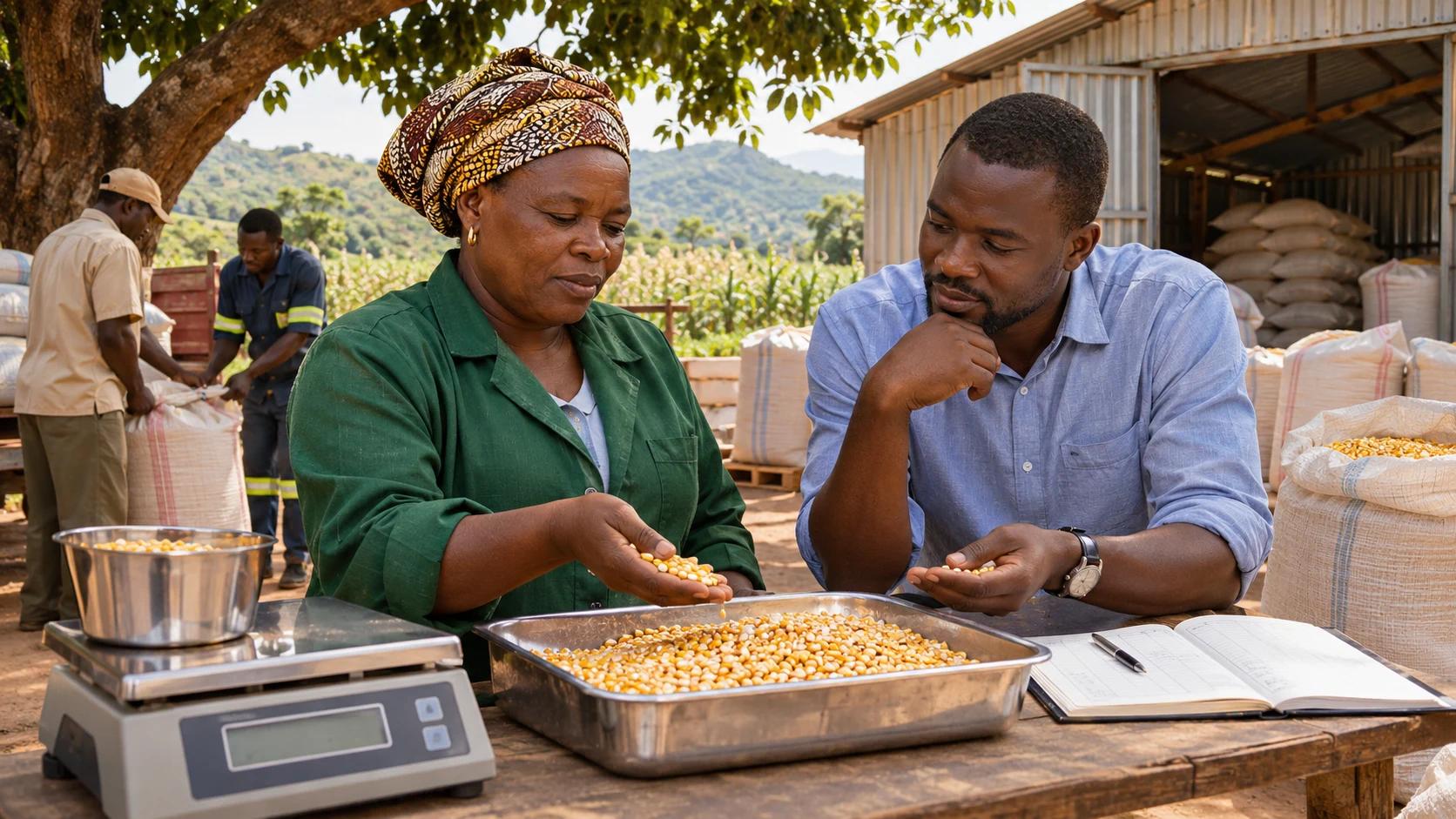
Two practical rules. First, check farm deliveries against farm size: a farmer delivering more cherry than the mapped plot could produce is probably selling a neighbour's coffee. Second, if a plot is over 4 hectares, a single point isn't enough. Many estates, and some larger smallholdings, need polygons.
A note on soluble coffee
Roasted and green coffee are already covered. From 30 December 2027, Delegated Regulation (EU) 2026/2102 adds coffee extracts, essences and concentrates, including soluble coffee (HS 2101 11 00). If you make instant coffee for the EU, plan for plot data to follow the beans into the factory.
What an EU buyer should ask
- Which national system are your farmers registered in, and what share of the farmers behind this lot are in it?
- Can you list the plots behind each lot, in GeoJSON, with polygons for plots over 4 hectares?
- How do your washing stations or factories log deliveries against farmer IDs?
- Which forest baseline did you check against, and how did you handle shaded plots that read as forest?
- Did farmers consent to the collection and sharing of their plot data?
- For auction lots: can the factory or marketing agent provide the farm list?
For how the three markets compare on price, grades and buying routes, see our East African coffee sourcing guide. For the cocoa version of this checklist, read EUDR and cocoa. Key dates are kept on our EUDR overview.
This guide is general information, not legal advice. Check country tiers and national system rules against official sources before making compliance decisions. Last reviewed: 17 November 2026.
AfroSynergy connects international buyers with African exporters. Listings open on 15 January 2027. To source a product or find a counterparty now, send us an enquiry.