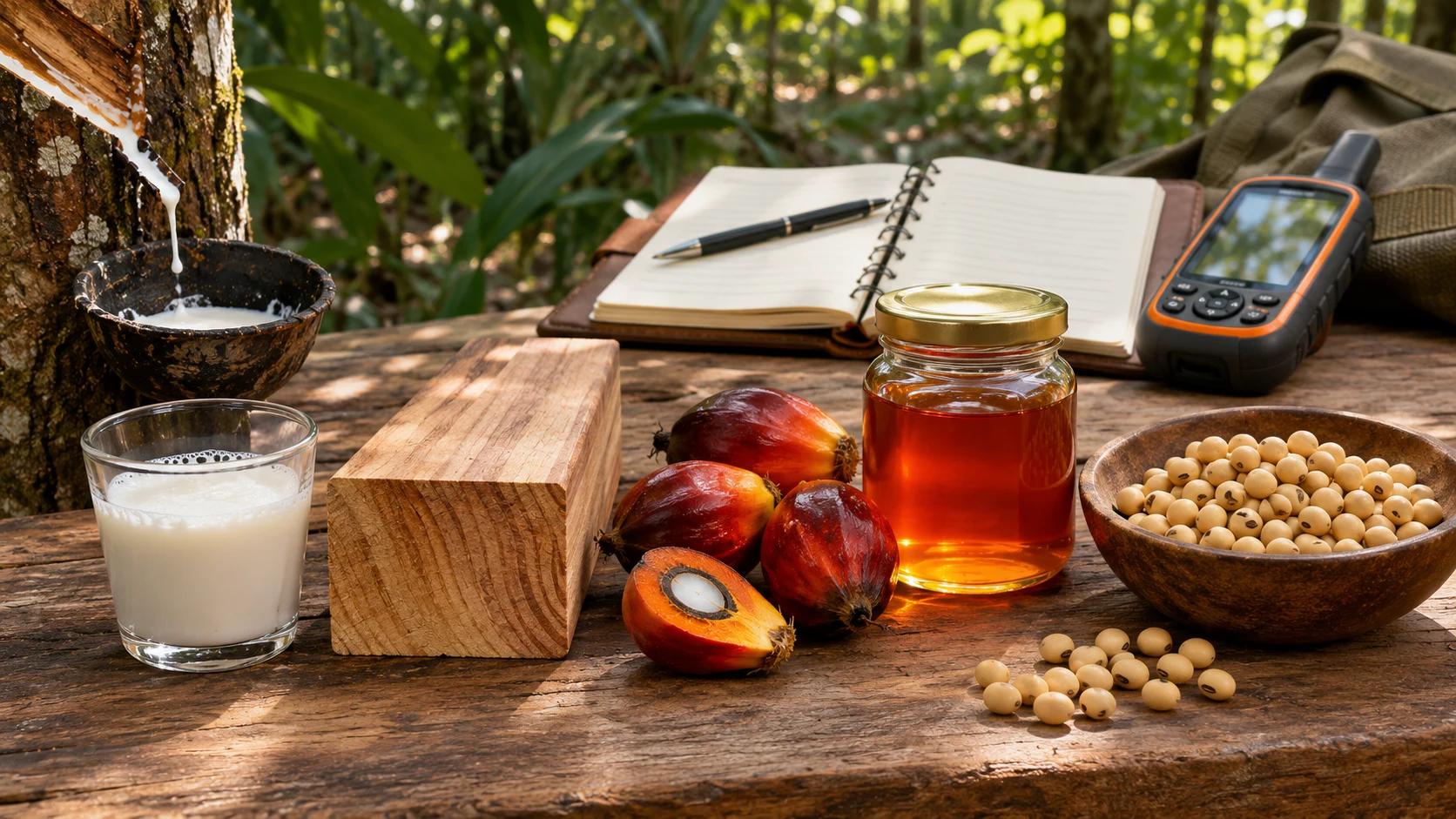
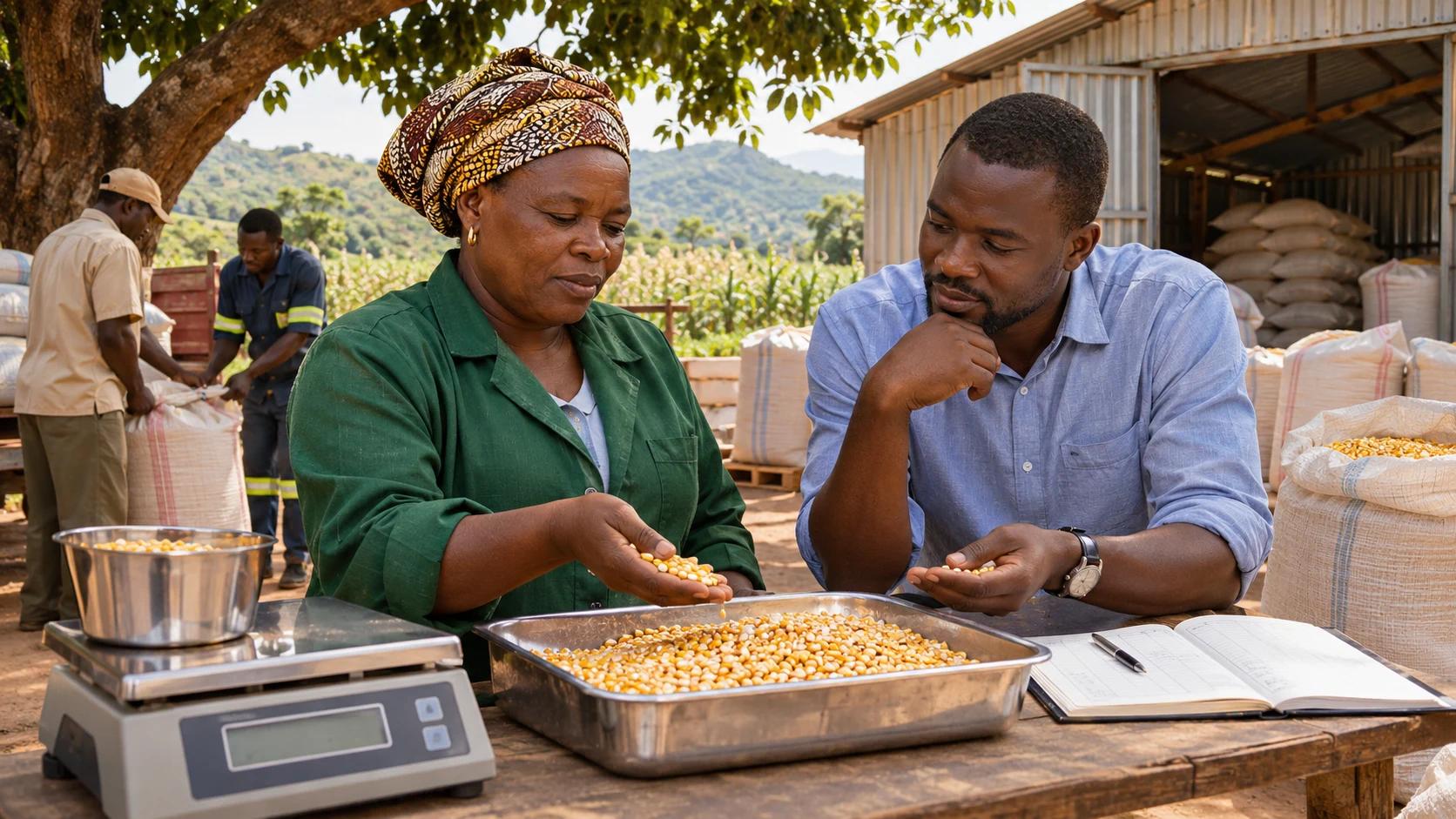
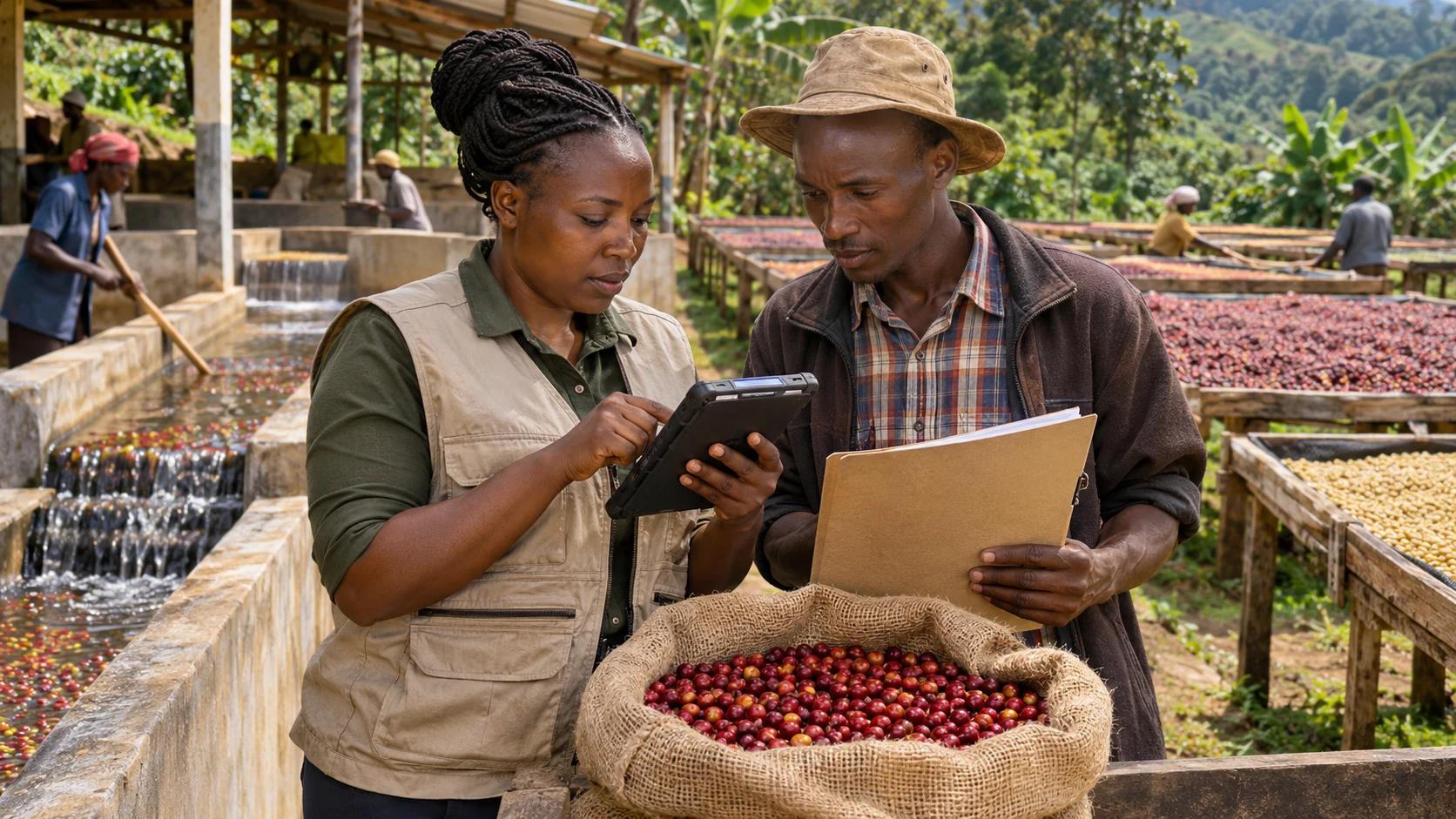
The EU Deforestation Regulation covers African timber, palm oil, rubber and soy on the same terms as cocoa and coffee: from 30 December 2026, an EU importer needs the geolocation of every plot or forest area that produced the goods, and evidence they are deforestation-free and legally produced. What differs is the chain. Timber needs concession and harvest records. Rubber and palm oil come mostly from smallholders. Soy reaches the EU in small volumes, often as niche non-GM feed. And in September 2026 the EU narrowed and widened the product list, which changes what exporters of these four commodities must document.
The general rules are in our hub guide, EUDR for African Exporters: What You Must Prove and When. This post covers the four commodities one by one.
First: the product list changed in 2026
Commission Delegated Regulation (EU) 2026/2102, published in the Official Journal on 17 September 2026, rewrote parts of Annex I, the list of covered products. The changes that matter for these four commodities:
| Commodity |
Removed or narrowed |
Added |
Applies from |
| Rubber |
Conveyor and transmission belts (HS 4010) and other vulcanised rubber articles (HS 4016) removed. Retreaded and used tyres (HS 4012) narrowed to tyre treads only. Scope limited to Hevea brasiliensis rubber. |
|
On entry into force |
| Wood |
Used and second-hand products excluded. Packaging that only supports, protects or carries another product excluded. Seats narrowed to wooden seats. Bamboo and rattan excluded. |
|
On entry into force |
| Oil palm |
|
Many palm-based derivatives: glycerol, fatty alcohols, fatty acids, esters, amines, soaps and industrial chemicals, where made using oil palm |
Most additions from 30 December 2027 |
| Soy |
Soya beans for sowing removed |
|
On entry into force |
Two consequences. A rubber exporter selling belts or other technical rubber goods to the EU may now be out of scope, but natural rubber itself is not. A palm exporter selling crude or refined oil is already covered, and from December 2027 so are many of the oleochemicals made from it.
Country tiers for these chains
The benchmarking list (checked 17 November 2026) puts Ghana, Gabon, Congo, Kenya and South Africa among the low-risk countries. Côte d'Ivoire, Liberia, Nigeria, Cameroon and the Democratic Republic of the Congo are not listed, so they are standard risk. No African country is high risk. Low risk means the EU buyer collects the data without a formal risk assessment, and 1% of operators are checked each year, against 3% for standard risk, under the amended EUDR. The geolocation requirement is the same in every tier.
Rubber: a smallholder crop with a concession layer
Where it comes from. Côte d'Ivoire is the world's third-largest natural rubber producer, behind Thailand and Indonesia, with about 10% of world output, per Financial Afrik (15 January 2026). Production roughly doubled between 2019 and 2023, and less than 0.1% is made into finished goods locally. The producers' association APROMAC put 2025 output at about 2 million tonnes, according to Daba Finance (10 November 2026), helped by farmers switching from cocoa to rubber.
How the chain works. Where a processing factory runs its own plantations and also buys from smallholders, often through collectors, it has two kinds of supply under one roof: estate rubber with known boundaries, and smallholder rubber whose origin depends on the collector's records.
What has to be recorded:
- every smallholder plot that supplies the factory, with a point for 4 hectares or less and a polygon above;
- every estate block, as polygons;
- intake records at the factory, linking each delivery of cup lump to the plots it came from;
- segregation of EU-bound processed rubber from rubber of unknown origin, through processing and baling.
Where it fails. Rubber planting has expanded fast. A plot converted from cocoa is not a deforestation problem, but a plot planted after 2020 on land that was forest at the end of 2020 fails, whoever planted it. Run every supplying plot against a 2020 forest baseline, and treat new plantings as the highest-risk part of the supply base. Côte d'Ivoire is standard risk, so the EU buyer must carry out a full risk assessment and will ask how you handle collectors.
Timber: legality is necessary, not sufficient
Who this affects. Exporters in the Central African forest countries (Cameroon, Gabon, the Republic of Congo, the DRC) and in West African timber producers such as Ghana.
The FLEGT question. Ghana issued Africa's first FLEGT licence for timber exports on 15 August 2025, per the international tropical timber association ATIBT, making it the second country in the world after Indonesia to do so. A FLEGT licence helps meet the EUDR's legality requirement. It does not prove that the wood is deforestation-free, and EU importers still need the coordinates of the plots where it was harvested, as Mongabay reported when the first licensed shipments began. Legal harvesting on land cleared after 2020 can still fail.
The EU Timber Regulation ends. The amended EUDR repeals the old EU Timber Regulation with effect from 30 December 2026, with transitional rules for some timber products. Micro and small operators handling wood already covered by the old timber rules don't get the extra six months that other small operators get.
What has to be recorded:
- the harvest area as polygons (concessions, annual allowable cut blocks or farm plots), not just a concession name;
- the date or period of harvest;
- legality documents: concession title, harvesting permit, transport documents, tax receipts and, where applicable, a FLEGT licence;
- a chain from the log to the sawn or processed product, so each export lot links to its harvest areas.
Where it fails. Mixing logs from several concessions or from community forests in one sawmill without log tracking. Timber from land-conversion permits, where forest was cleared legally for a farm or a mine after 2020: legal, but not deforestation-free. And processed products (plywood, mouldings, furniture parts) where the link between the product and the harvest area isn't recorded.
Gabon and the Republic of Congo being low risk lowers the buyer's assessment work. It doesn't lower the harvest-area data required.
Palm oil: small EU volumes, big derivative scope
Where it comes from. West Africa consumes more palm oil than it produces and imports the difference, per the 2025 Palm Oil Barometer published by Solidaridad. Most production is from smallholders: about 81% of the oil palm area in Ghana, 73% in Côte d'Ivoire, and about 80% of production in Nigeria. An exporter selling palm products to the EU is therefore usually sourcing, at least in part, from smallholders it does not control.
What has to be recorded:
- plantation blocks as polygons, and outgrower or smallholder plots as points or polygons by size;
- mill intake of fresh fruit bunches, linked to the plots that supplied them;
- segregation from the mill to the refinery and the tank, since a tank of mixed oil can't be traced back;
- for derivatives: the link from the product (glycerol, fatty acids, soap) back to the oil it was made from.
Where it fails. Mills that buy fruit bunches from independent smallholders through dealers, with no plot record. Refineries that process imported crude alongside local oil in the same tanks. And the 2027 derivative scope: an oleochemical or soap exporter who doesn't think of itself as a "palm" company is covered from 30 December 2027 for many products.
Soy: small volumes, high scrutiny
Where it comes from. African soy exports to the EU are small next to the Americas. The niche where Africa matters is non-GM and organic soy for animal feed, and that is where EU feed buyers are worried. In its September 2026 risk assessment, FEFAC, the European feed manufacturers' federation, rated non-GM and organic soy for feed from West Africa, notably Nigeria, as high disruption risk, because EUDR readiness there is uncertain. It expected only about 50% of normal availability from those origins.
What has to be recorded:
- every farm plot, by point or polygon;
- aggregator and warehouse records, linking each bag or truckload to plots;
- segregation at the crushing plant or export warehouse;
- for organic or non-GM claims, the certification chain alongside, not instead of, the EUDR data.
Where it fails. Wherever soy from many small farms is pooled by aggregators before it reaches a warehouse, the plot list is lost at the first truck. A buyer paying a premium for non-GM soy from these origins should expect to fund or co-design the plot mapping.
One checklist for all four
| Question |
Rubber |
Timber |
Palm oil |
Soy |
| Is my product still in Annex I after 2026/2102? |
Natural rubber: yes. Tyre codes: check the new Annex. Belts and other articles (4010, 4016): no. |
Most wood products; not used goods or packaging |
Oil yes; many derivatives from Dec 2027 |
Beans, meal, oil yes; seed for sowing no |
| Unit to geolocate |
Smallholder plot and estate block |
Harvest area or concession block |
Plantation block and supplier plot |
Farm plot |
| Where mixing happens |
Collectors, factory intake |
Sawmill log yard |
Mill intake, refinery tanks |
Aggregators, warehouses |
| Legality evidence |
Land rights, factory permits |
Concession, harvest permit, FLEGT licence (Ghana) |
Land rights, plantation permits |
Land rights, farm records |
Each of these chains is easier when the exporter controls its own production or its first purchase. If you are an EU buyer looking for suppliers who can document plots from 2027, start with exporters who already run estates or segregated outgrower schemes. For cocoa and coffee, see EUDR and cocoa and EUDR and coffee. Dates and scope are summarised on our EUDR overview, and the commodity context sits on our sector pages.
This guide is general information, not legal advice. Annex I and the country list can change: check the official texts before making compliance decisions. Last reviewed: 17 November 2026.
AfroSynergy connects international buyers with African exporters. Listings open on 15 January 2027. To source a product or find a counterparty now, send us an enquiry.