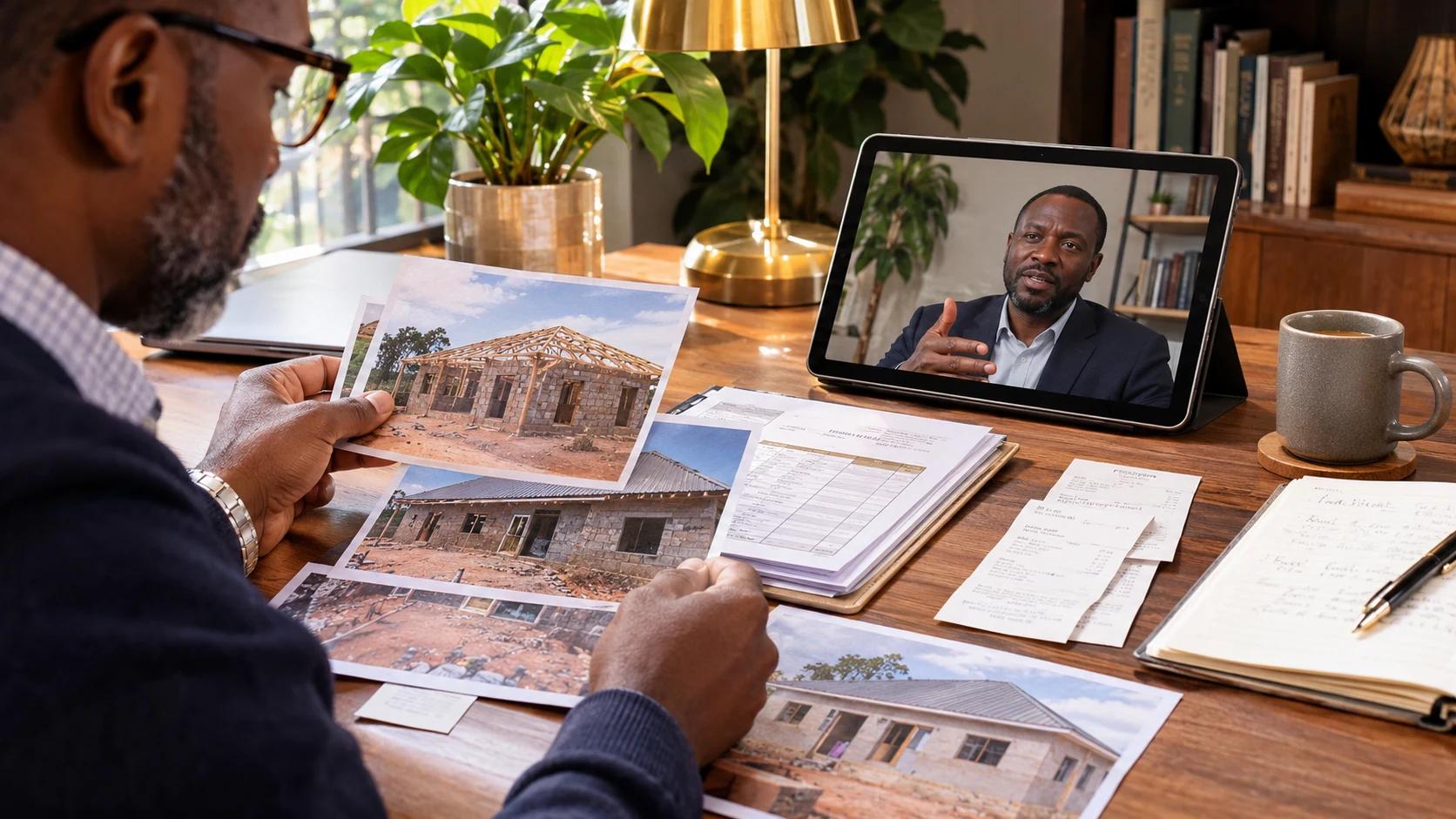
To buy land in Nigeria from abroad, have your own solicitor check four things before any money beyond a small deposit moves: the seller's certificate of occupancy or other title against the state land registry, a survey plan charted by the state's Surveyor-General, the Governor's consent on every earlier transfer, and that the land is not under government acquisition. Then complete the deed of assignment, stamping, registration and your own Governor's consent after you pay.
Section 22 of Nigeria's Land Use Act says the holder of a statutory right of occupancy may not assign, mortgage, transfer possession of or sublet it "without the consent of the Governor first had and obtained." That one clause explains why so many diaspora property purchases go wrong. A buyer in London or Houston pays for a plot, receives a deed and believes the transaction is finished. Until the Governor's consent is obtained, it is not.
Nigerians abroad buy land and homes in Lagos, Abuja and their home states for good reasons: rental income, a place to retire, something to leave their children. Some end up with exactly that. Others end up with a disputed title, an unfinished building or a property they own on paper but cannot use. The difference is rarely the property. It is the process: whether the title was checked before money moved, whether the buyer had independent legal advice, whether the buyer understood what the documents actually conveyed, and whether anyone reliable was on the ground at the right moments.
This guide walks through buying Nigerian land or property from overseas: the documents, the checks, payment, and managing it after completion. It is general information. Your solicitor's advice on your transaction comes first.
Why buying from abroad raises the risk
Distance creates an information gap. A buyer in Lagos can visit the site several times, talk to neighbors and walk into the land registry. A buyer abroad works from what the seller or agent provides, and the gaps may not show until after payment.
Time zones squeeze due diligence. A buyer with a full-time job abroad does research in evenings and weekends, and the pressure pushes people to accept informal assurances.
Emotion raises tolerance for risk. Property at home is often about belonging, an intention to return or standing in the family. A buyer who would demand a title search for a commercial deal may skip it for a family plot because the pull of ownership outweighs caution.
Trusted intermediaries are the usual route for fraud. A relative, a church contact or a hometown association member introduces the deal, and the relationship suppresses the questions the buyer would ask a stranger. Checking a relative's recommendation as hard as a stranger's feels costly. Not checking it costs more.
Step 1: Find the land through a channel you can check
Where you find the property decides how much work it takes to trust the basic facts.
- Established developers. For off-plan units, a developer with completed projects you can visit and former buyers you can call gives you something to check. It does not remove completion risk. Ask to see the developer's title to the whole estate, its approvals and its record of delivering on schedule.
- Registered professionals. The Estate Surveyors and Valuers Registration Board of Nigeria (ESVARBON) regulates estate surveying and valuation and publishes a register of individual practitioners and firms. Check any surveyor or valuer you use against that register. Registration gives the professional something to lose for misconduct. It does not tell you anything about the property.
- Listing portals. Most property portals carry listings without checking title. Treat any listing, however polished, as an advertisement. If a site says a listing is "verified," ask what was checked, by whom and against which record.
- Family and community introductions. These are legitimate ways to find a property. They are a source of leads, not a form of verification. The checks below apply whoever made the introduction.
Step 2: Check the title documents
Title investigation is how you find out whether what the seller is offering is what you will receive. Skipping it is the most common cause of diaspora purchases that fail.
The documents you will see, and what each one means
Section 1 of the Land Use Act vests all land in each state in the Governor of that state. Individuals and companies hold rights of occupancy, not freehold ownership in the English sense. Section 9 provides for the Governor to issue a document evidencing the right, called a certificate of occupancy (C of O). Section 26 adds that any transaction or instrument conferring an interest in land "other than in accordance with the provisions of this Act shall be null and void." What that means for a deed signed before consent is granted is a question for your solicitor, on your facts.
Other documents you will meet include the deed of assignment, which transfers an existing right of occupancy from one holder to another; the Governor's consent to that assignment, required under section 22; and survey plans that fix the land's boundaries. Ask your solicitor to explain, for the specific property, which documents exist, which are registered and what each one does and does not give you.
If you no longer hold Nigerian citizenship, ask whether state law treats you as a foreigner. Lagos, for example, has an Acquisition of Lands by Aliens Law that defines an alien as any individual other than a Nigerian. Firmus Advisory's May 2026 guide, published on Legal 500, says a foreigner's lease in Lagos cannot run longer than 25 years, counting the first renewal option, and that some transactions need prior approval depending on their structure and length. Our comparison of whether foreigners can buy property in Nigeria, Kenya or Ghana sets out what a non-citizen can hold in each country.
As a working rule: a registered C of O, with Governor's consent on every later transfer and a survey plan recorded with the state survey authority, is the strongest position. Documents that represent an intermediate step, such as a deed of assignment without consent, an allocation letter without a C of O, or a developer's own paperwork before transfer, may give you possession or a contractual claim but not completed legal title.
The checks your solicitor runs
Instruct a solicitor with property experience in the relevant state to carry out these checks.
- Registry search. A search at the state land registry to confirm the seller's title is registered, matches the registry record and carries no undisclosed entries such as cautions, injunctions or mortgages. This is the most important single check. If the title is unregistered or inconsistent with the registry, stop.
- Survey plan check. Confirm the survey plan is charted, meaning recorded and plotted by the state's Surveyor-General. An uncharted plan means the land's description is not confirmed in the official record.
- Chain of consent. Where the seller bought from an earlier holder, trace each assignment back to the original grant and confirm Governor's consent was obtained for each one. Ask your solicitor what a missing consent in the chain means for your position.
- Government acquisition check. Confirm the land is not under a government acquisition, and if it was acquired, that the relevant part was formally released (excised). Land under an acquisition that was never released cannot give you good private title, whatever the seller says.
- Physical inspection. Confirm the land on the ground matches the survey plan, and look for occupiers or competing claims. Where several parties claim the same land, an inspection finds what documents miss.
Step 3: Use independent legal representation
Every significant purchase needs a solicitor who acts only for you. Not a relative who happens to be a lawyer. Not the developer's recommended lawyer, whose interest is in closing. A solicitor you instruct and pay.
That solicitor should:
- draft or review the sale agreement, covering price, the title being conveyed, conditions that must be met before payment, the completion timeline and your remedies if clear title is not delivered;
- carry out or supervise the title investigation above;
- prepare or review the deed of assignment so it describes the property, the price, the parties and the right being transferred accurately;
- apply for Governor's consent on your behalf, because without it your legal title is incomplete;
- explain stamp duty, registration fees and the tax that may apply when you eventually sell, and the deadlines for each.
Agree the fee in writing before work starts. Then stay involved. A buyer who instructs a solicitor by email and disappears until completion becomes the bottleneck in their own transaction. If you cannot be present, ask your solicitor whether a properly drafted power of attorney to a trusted representative is appropriate.
Step 4: Pay against documents, not promises
Payment should follow documentation. Buyers break this rule under time pressure from the seller, out of trust in the introducer, or out of fear of losing the property.
- A small deposit against a signed preliminary agreement. The agreement should say what happens to the deposit if the title investigation finds a problem. Keep the deposit small enough to lose without real harm.
- The balance only after clear title is confirmed. Pay the rest when the solicitor's title report is complete, the deed of assignment is approved and the documents are in order. A seller's "trust me, the title is clean" is not a title report.
- Traceable channels only. Pay by bank transfer to the solicitor's client account or to the seller's own account, after checking the account name matches the seller. Never pay cash. Never pay into a third party's account.
- Keep the paper trail. Banks on both ends may ask where the money came from. Keep transfer confirmations and statements. Ask your receiving bank what documentation it needs for a transfer of your size.
Step 5: Finish the job after payment
- Stamp duty and registration. The deed of assignment must be stamped with the state revenue authority and registered. Your solicitor should handle both and tell you the deadlines.
- Governor's consent. Have your solicitor file the application promptly after completion and ask for a realistic timeline in your state. Until consent is granted, treat your title as incomplete.
- Original documents. Keep originals somewhere secure. Buyers who leave originals with a relative or agent have had them lost or misused. A safe deposit facility, or originals kept abroad with certified copies in Nigeria, is safer.
- Management. An unmanaged property earns irregular rent, deteriorates and is exposed to encroachment and squatting. You need a property manager, either a firm with a record you can check and a written reporting arrangement, or a relative or associate with both the ability and the accountability. Agree fees, remittance dates and inspection reports in writing. Where possible, have tenants pay rent straight into your account.
Common frauds aimed at diaspora buyers
- Duplicate sales. The same land is sold to several buyers, often using deeds that are not yet registered. The registry search before payment and a prompt consent application after completion close that window.
- Forged documents. Fake or altered titles. The defense is checking every document against the registry, not against a photocopy.
- Community or family land sold as clear title. Land subject to family or community claims, or with disputed boundaries, sold under a deed that hides those interests. Lagos passed a Properties Protection Law in 2016 that bars anyone from using force or self-help to take over land, and the state's Special Taskforce on Land Grabbers had received 7,500 petitions by February 2024, according to the Lagos State Ministry of Justice. Ask your solicitor to look specifically for competing claims, not only the registered chain.
- Manufactured urgency. "Three other buyers are ready today." Write an investigation period into the preliminary agreement and treat pressure to shorten it as a warning.
- Payment diversion. An email that appears to come from your solicitor or the seller announces new bank details just before completion. The FBI's Internet Crime Complaint Center counts this as business email compromise; its 2025 report logged 24,768 such complaints and about $3.05 billion in reported losses, second only to investment fraud. Confirm any change of account details by phone, on a number you already hold.
- Inflated or double agency fees. Agents who charge above the norm or collect from both sides without disclosure. Agree fees in writing at the start and ask your solicitor whether they are in line with local practice.
Build your team on the ground
Every protection in this guide depends on someone reliable being present, whether that is you or people acting for you. The minimum team:
- a property solicitor who acts only for you, with property experience in the relevant state; interview two or three, ask for references and confirm they are called to the Nigerian Bar;
- a registered estate surveyor and valuer, checked against the ESVARBON register, for an independent valuation before you agree a price;
- a property manager chosen before completion, so the property is never unsupervised;
- optionally, a trusted local contact who can visit on request and handle physical documents.
Your next step: before you send any money beyond a small deposit, instruct an independent solicitor in the relevant state and ask for a written title report covering the registry search, the survey plan, the chain of Governor's consent and any government acquisition.
AfroSynergy connects international buyers with African exporters. Listings open on 15 January 2027. To source a product or find a counterparty now, send us an enquiry.