
Market Entry, 6 November 2026, 7 min read
Egypt or Morocco as a Gateway to Africa? Comparing the Two
Morocco suits Europe-facing manufacturing and West African reach. Egypt suits a large home market, COMESA and the Suez corridor. Here's the sourced comparison and how to choose.
The short answer
Base in Morocco if you make or assemble goods for Europe, want a stable currency and a fast port into the Atlantic and Mediterranean, or plan to reach francophone West Africa, where Moroccan banks are already established.
Base in Egypt if your product needs a large home market, you sell into COMESA countries in East and Southern Africa, or your logistics depend on the Suez Canal and the Red Sea.
Run both only once you have revenue in both directions. They face different halves of the continent.
The useful question is not which country is the better "gateway to Africa". Neither is a gateway to all of it. Ask which part of Africa your first three years of revenue will come from, and which country already trades with that part.
The comparison, with sources
Figures are the latest we could verify as of 17 November 2026.
| Factor | Morocco | Egypt |
|---|---|---|
| Nominal GDP, 2024 (World Bank) | $160.6bn | $389.1bn |
| Population, 2024 (World Bank) | 38.1 million | 116.5 million |
| Real growth forecast, 2026 (IMF, Oct 2026 WEO) | 4.5% | 5.1% |
| Headline corporate tax | 20% below MAD 100m of profit; 35% at MAD 100m or more; 40% for banks and insurers (PwC, reviewed 30 Apr 2026) | 22.5% (PwC, reviewed 17 Aug 2026) |
| FX regime | Dirham managed against a basket; Bank Al-Maghrib plans more flexibility only gradually from 2027 | Pound moved to a flexible rate in March 2024; the IMF says movements should stay market-determined |
| Flagship port | Tanger Med: 11.1 million TEU in 2025, up 8.4% | Suez Canal corridor: transits up 27% year on year in August 2026, revenue $567.1m that month |
| EU trade deal | Association Agreement in force | Association Agreement in force |
| US trade deal | US-Morocco Free Trade Agreement | None on the USTR list |
| African regional bloc | No sub-Saharan bloc membership; reach runs through banks and investment | COMESA member |
| AfCFTA tariff schedule in domestic law | Yes | Yes |
| FATF grey list | Not listed after the October 2026 plenary | Not listed after the October 2026 plenary |
Four notes on reading that table.
Egypt is the bigger market by a wide margin. It has about three times Morocco's population and well over twice its GDP. If your model depends on domestic volume before regional sales, that gap matters more than any incentive.
The two currencies behave differently. Egypt moved its pound to a flexible regime in March 2024, and the IMF's February 2026 review asked Egypt to keep the rate market-determined and limit intervention to disorderly conditions. Egypt's $8bn IMF programme was extended to the end of 2026. Morocco's dirham is managed, was near-stable against the euro in April and May 2026, and Bank Al-Maghrib has said full flexibility will come slowly. For a business that prices in local currency, Morocco is easier to plan in; for one that earns hard currency and spends locally, Egypt's flexible rate can work in its favour.
The Gulf war hangs over both forecasts. The IMF's October 2026 outlook expects the Middle East and North Africa to contract 3.8% in 2026, and assumes the Strait of Hormuz begins reopening only in March 2027. Egypt's upgrade rests partly on recovering Suez Canal activity, and the Fund flags further shipping disruption as a downside risk. Morocco's Atlantic and Strait of Gibraltar position is less exposed to that particular risk.
AfCFTA treats them the same on paper. Both are among the 25 countries that, by February 2026, had written their AfCFTA tariff schedules into domestic law, according to the US Commerce Department. Whether your product benefits depends on the schedule of the destination country too. Check it on /afcfta before you build a regional plan on preferences.
Choose Morocco if…
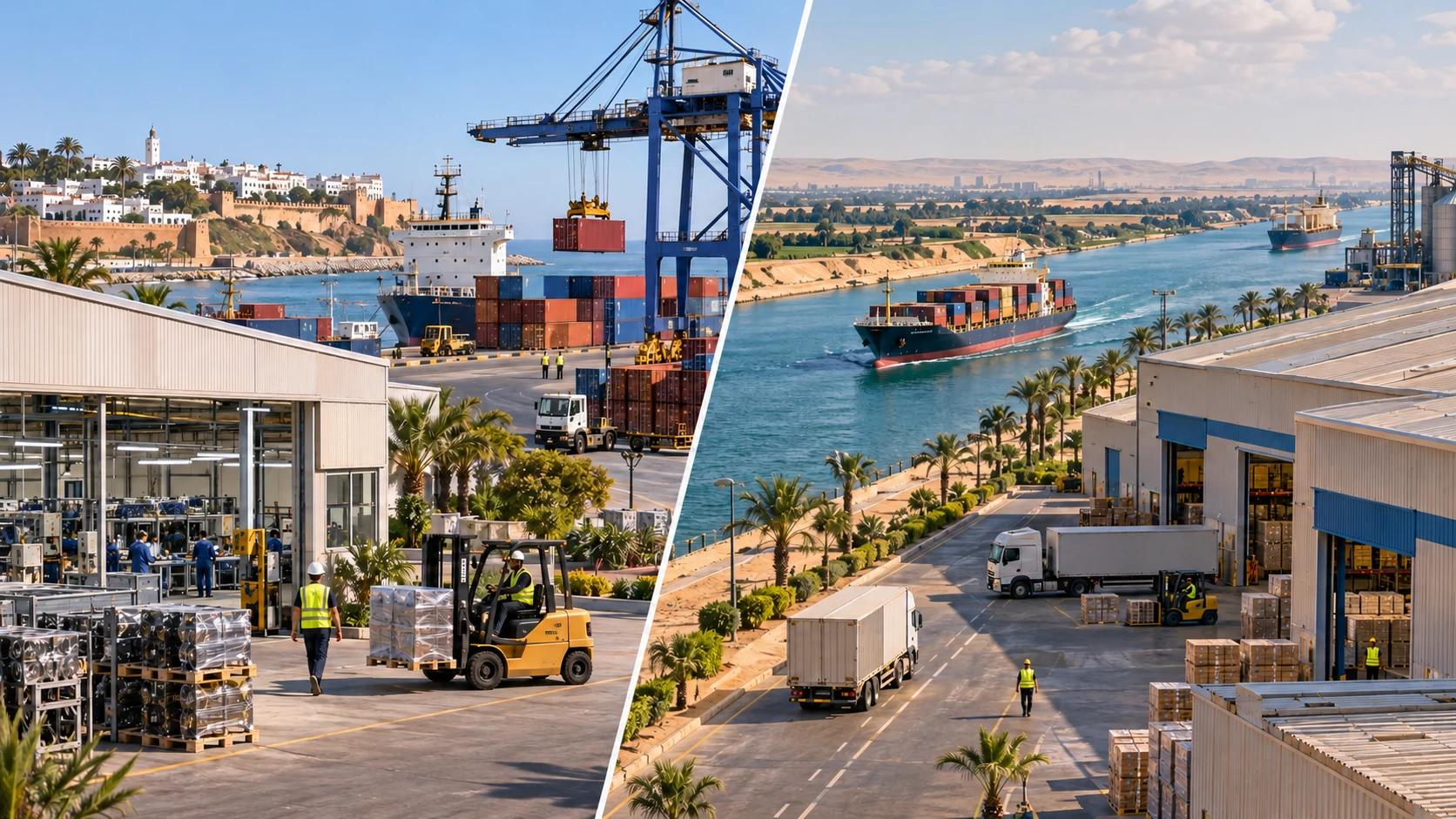
You manufacture for Europe. Tanger Med sits on the Strait of Gibraltar, and it handled 11.1 million TEU and 161 million tonnes of cargo in 2025. Combined with the EU Association Agreement and the US FTA, that makes Morocco a strong base for assembly and light manufacturing aimed at Western markets, with Africa as a second market.
You want a predictable tax position. The 20% rate applies to companies earning under MAD 100 million and to firms in Morocco's Industrial Acceleration Zones, per PwC. Large profit-makers pay 35%, so model your expected profit band before you choose a structure.
Your African customers are in West and Central Africa. Moroccan banking groups have built networks across the region. Attijariwafa Bank, Banque Centrale Populaire and Bank of Africa are described by Morocco World News as among the most established pan-African banking groups, strongest in West and Central Africa. Bank of Africa drew 43% of its net income attributable to shareholders from sub-Saharan Africa in the first half of 2025. A bank that already operates in Abidjan, Dakar or Douala makes collections and trade finance easier. If those markets are your target, our guide to francophone Africa and the BCEAO zone covers the currency and legal background.
You value currency stability over market size. A managed dirham means fewer surprises in local costs and salaries.
What it costs you. A domestic market of 38 million is modest. Morocco is not a member of COMESA, the EAC or SADC, so East and Southern Africa are a long way off commercially. The 35% rate bites if you become very profitable. And the dirham's managed regime may change from 2027.
Choose Egypt if…
Your product needs a large home market. About 117 million people gives you volume to build a business on before you export a single unit.
You sell into East and Southern Africa. Egypt is a member of COMESA, the common market that includes Kenya, Ethiopia, Uganda, Rwanda, Zambia and others. That gives you a regional preference system and an established trade relationship with markets Morocco reaches only through the AfCFTA.
Your logistics run through Suez and the Red Sea. If you serve Asia, the Gulf and East Africa as well as Europe, Egypt sits on the route between them. The Suez Canal Economic Zone (SCZONE) is built around that position.
You earn hard currency and spend locally. Under a flexible pound, a weaker currency lowers your local costs in dollar terms. That helps an exporter, provided you can manage the currency risk on any local sales.
What it costs you. Your Suez-based plan depends on Red Sea and Gulf shipping, which the IMF itself lists as a risk. Pound-denominated revenue loses value in dollar terms when the currency moves. And the IMF programme ends in December 2026, so watch what replaces it.
The hybrid option: two hubs, sequenced
For a business that genuinely needs both halves of the continent:
- Open where the first revenue is. European and West African customers point to Morocco. Egyptian, Gulf and East African customers point to Egypt.
- Serve the other side through partners first. Use a distributor or agent before you open a second entity. Check them properly; see how to find a distributor in Africa and check them.
- Add the second hub when partner revenue justifies it. A useful trigger is when the partner's margin on your volume exceeds what a small local team would cost.
- Decide the holding structure separately. Tax treaties, investor preferences and exit plans drive where the holding company sits. Take advice in both countries.
If sub-Saharan Africa is the real target, neither North African base is a substitute for a presence in Lagos, Nairobi or Johannesburg. Our comparison of South Africa and Nigeria as expansion bases covers those choices.
Decision checklist
Answer these in order. Stop when the answer is clear.
- Where is 60% or more of your three-year revenue? Europe or West Africa → Morocco. Egypt, the Gulf or East and Southern Africa → Egypt. Split → two hubs, sequenced.
- Does your model need a big domestic market first? If yes, lean Egypt.
- Are you manufacturing for Western markets? If yes, lean Morocco for Tanger Med, the EU agreement and the US FTA.
- How exposed is your supply chain to Red Sea and Gulf shipping? High exposure argues for Morocco or for a contingency plan in Egypt.
- Do you price locally or earn hard currency? Local pricing favours Morocco's managed dirham. Hard-currency earnings with local costs can favour Egypt.
- Have you modelled tax in both? Morocco's 20% or 35% against Egypt's 22.5% is the headline only. Zone incentives, withholding taxes and treaties change the answer.
- Who will run it? A strong country manager matters more than the choice of city. If you have the right person in Casablanca, Tangier or Cairo, that can settle it.
Still undecided? Map your buyers or suppliers by country on /markets and put the base on the side of the continent where the map is densest.
AfroSynergy connects international buyers with African exporters. Listings open on 15 January 2027. To source a product or find a counterparty now, send us an enquiry.
Comments
Sign in to leave a comment. Comments are moderated.
Keep reading
Sourcing from Africa?
Listings open on 15 January 2027. Tell us what you need to source and we will come back to you.
Or get new guides by email.
By subscribing you agree to our Privacy Policy. Unsubscribe anytime.