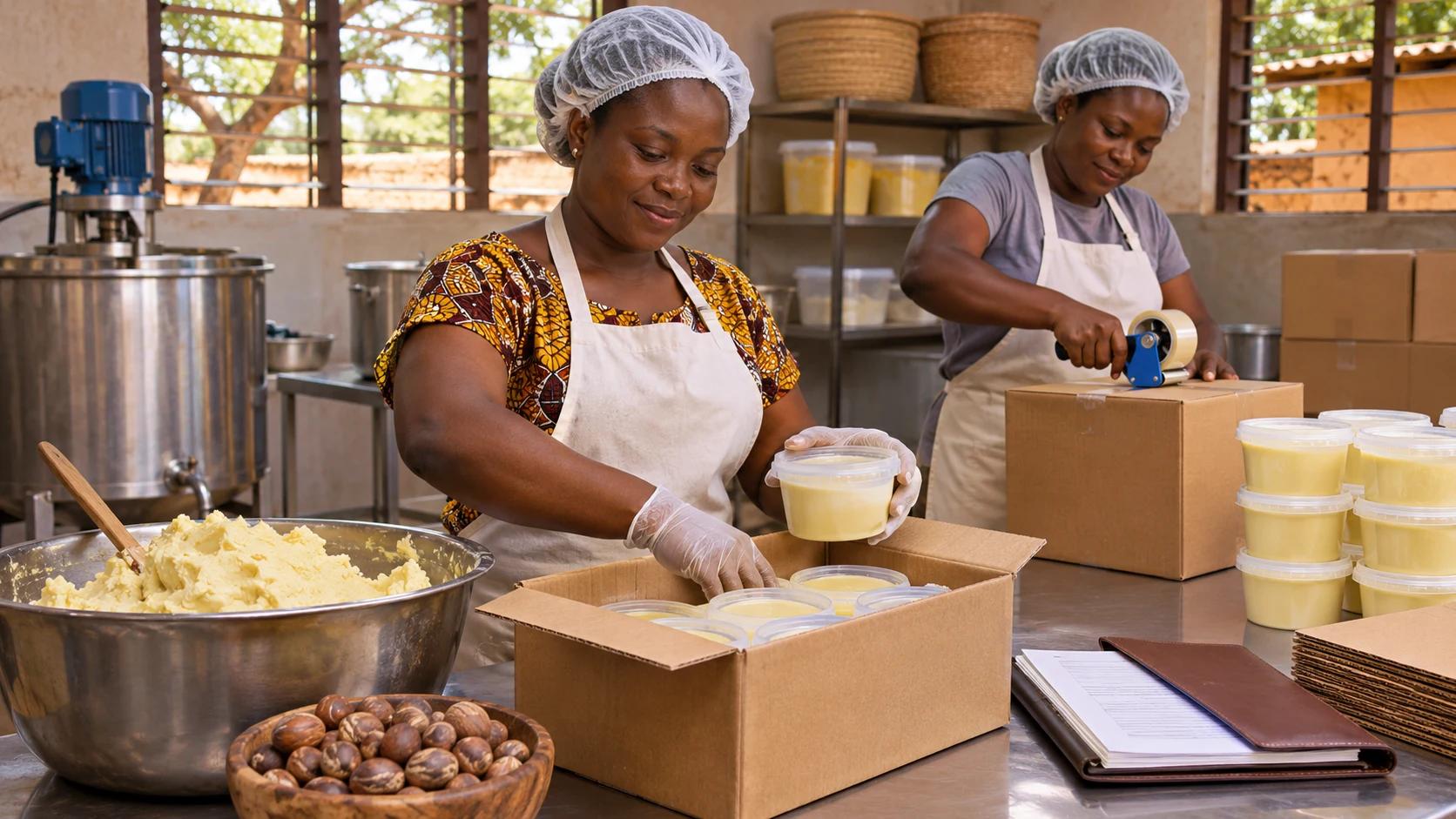
For an SME, the main AfCFTA benefit is a lower or zero import duty in another African market. It applies only when three things line up: the importing country has cut the tariff on your product's HS code, the product meets the rule of origin, and you present valid proof of origin at the border.
A shea butter processor in Tamale wants to sell to a distributor in Dakar. The African Continental Free Trade Area (AfCFTA) says the duty on that shipment should fall. Whether it falls at the Senegalese border depends on three things the headlines skip: the importing country's tariff schedule, whether the product meets the rules of origin, and whether the exporter holds a valid certificate of origin.
The projections are large. The World Bank's 2020 study estimated that full implementation could raise Africa's real income by about 7%, close to $450 billion, by 2035, and lift 30 million people out of extreme poverty. A 2022 World Bank update prepared with the AfCFTA Secretariat put the income gain at 9% by 2035 and the poverty reduction at 50 million people. Both describe full implementation. This guide covers the three gates an SME must pass to get the benefit (tariffs, origin rules and certificates), and which barriers the agreement has not yet reached.
What AfCFTA actually is
The agreement entered into force on 30 May 2019, after the 22nd instrument of ratification was deposited. Trading under it formally began on 1 January 2021. It is a framework agreement: the obligations sit in protocols, annexes and each country's schedules.
It works on three tracks.
Goods. The tariff modalities the African Union Assembly confirmed in February 2019 require each country to remove tariffs on 90% of tariff lines: over five years for non-least-developed countries and ten years for least developed countries. Up to 7% of lines can be designated sensitive and liberalised more slowly, over ten and thirteen years respectively. Up to 3% of lines can be excluded, provided they account for no more than 10% of the value of imports from other African countries.
Services. Countries open service sectors through schedules of specific commitments. Whether a consulting, logistics or financial services firm benefits depends on what the target country has committed in that sector.
Rules beyond tariffs. The AU Assembly adopted protocols on investment, competition policy and intellectual property rights at its 36th ordinary session in February 2023. It adopted the Protocol on Digital Trade at its 37th session in February 2024, and annexes to that protocol followed. The digital trade protocol needs 22 ratifications to enter into force, so it is adopted law that is not yet operational.
The practical reading: AfCFTA is in force, but how far it reaches a given shipment varies by country, product and sector.
Tariffs: what has actually been cut for SMEs
Each country liberalises on its own schedule. The rate that applies to your goods is the rate in the importing country's schedule for your HS code in the current year, if you qualify for preference. The AfCFTA e-Tariff Book publishes those rates by country pair and product.
The Guided Trade Initiative tested the system with real shipments. It launched in Accra on 7 October 2022 with eight countries: Cameroon, Egypt, Ghana, Kenya, Mauritius, Rwanda, Tanzania and Tunisia. Each had deployed the e-Tariff Book and the Rules of Origin Manual. South Africa joined in January 2024, and Nigeria joined in the initiative's second phase in 2024, according to ODI. In October 2024 the AfCFTA Secretary-General, Wamkele Mene, said 39 countries would trade under the initiative. The Secretariat does not publish a current participant list, so check with your trade ministry whether your country and your product are covered. The initiative was designed to test the operational, institutional and legal environment, not to carry volume.
Regional agreements still do most of the work. For most SMEs the preference they can use today comes from their regional economic community: ECOWAS, the East African Community, SADC or COMESA. The Tamale-to-Dakar shipment, for example, falls under the ECOWAS Trade Liberalisation Scheme. An industrial product traded under that scheme needs an ETLS certificate of origin. Each certificate is valid for six months from issue, covers one type of product, and can be used for one destination country in the ECOWAS region. A separate certificate is needed for each product type.
The near-term gain is largest inside existing regional corridors. AfCFTA's added value grows where it reaches country pairs that had no preferential arrangement before. Our AfCFTA opportunity map looks at which country pairs have the most untapped trade potential.
Rules of origin: the qualification gate most SMEs miss
A preferential rate applies only to goods that originate in a State Party. Rules of origin stop a product made elsewhere from being relabelled in one African country and shipped to another at the African rate.
Annex 2 of the agreement sets two routes to origin.
Wholly obtained goods. Goods grown, harvested, extracted or born and raised in a State Party. Cocoa beans grown in Côte d'Ivoire are the simple case.
Sufficiently worked or processed goods. Products made with imported inputs must meet a product-specific rule. Depending on the product, the rule is a value-added test, a ceiling on non-originating material content, a change in tariff heading, or a specific process. The product-by-product rules are in Appendix IV to Annex 2. The last outstanding rules, for automotive products and for textiles and clothing, were adopted in early 2026, so the rules are now agreed for every product, according to a March 2026 AfCFTA newsletter published by AmCham South Africa. Look up the current rule for your heading in the e-Tariff Book, which publishes the rules of origin alongside the tariffs.
A Kenyan garment maker that cuts and sews imported fabric has to check the specific rule for its HS heading. Cutting and sewing may or may not be enough. The answer is in the appendix, not in general guidance.
Rules of origin are the main reason a promised tariff cut does not show up on an invoice. Check the rule for your product before you quote a delivered price.
Certificates of origin: the paperwork that claims the benefit
Goods that qualify on substance but arrive without valid paperwork pay the full rate. Article 17 of Annex 2 accepts three forms of proof of origin, as South Africa's customs rules implementing the annex reproduce it:
- a certificate of origin, in paper or electronic form, issued in the exporting country;
- an origin declaration made by the exporter on the commercial documents;
- a supplier's or producer's declaration, used to support the exporter's own proof.
Any proof of origin is valid for 12 months from the date it is issued in the exporting country, and it must reach the importing country's customs within that period. A certificate that expires while the goods wait at a port does not carry the preference.
Who issues it. The competent authority differs by country: a chamber of commerce, the trade ministry or customs. An exporter can also apply for approved exporter status in its own country. An approved exporter's origin declaration must carry its customs authorisation number, and the status can be withdrawn. The World Customs Organization's 2023 practical guide to the AfCFTA rules of origin walks through the process.
What sits behind it. The exporter must keep the supplier's declarations and the supporting documents that prove origin, and produce them if customs asks. Keep your origin calculation with them.
Regional certificates are separate. A shipment claiming a regional preference instead uses that scheme's paperwork, such as the ETLS certificate described above for ECOWAS. Ask your competent authority which certificate your route needs.
The non-tariff barriers AfCFTA has not solved
Tariffs are the visible cost. Clearance time, paperwork, standards and payment friction often decide whether a corridor is worth serving.
Customs and border procedures. Clearance times and documentation vary widely by border post and product. Budget for the real clearance time on your corridor, not the official one. Ask a freight forwarder who files at that border every week.
Standards and conformity assessment. A food or cosmetic product registered in one country may need separate registration in another. Mutual recognition of standards is among the most valuable things the agreement could deliver for SMEs, and among the slowest.
Payments and currency. Access to foreign exchange and the cost of converting between African currencies differ by country. The Pan-African Payment and Settlement System (PAPSS), developed with Afreximbank under an African Union mandate, was launched for public use in Accra on 13 January 2022. It lets participating banks settle cross-border payments in local currencies. Ask your bank whether it is connected and what it charges.
Documentation. Export licences, product registrations, certificates of origin and import permits each come from a different agency with its own timeline and fees.
Physical infrastructure. No trade agreement fixes a congested port or an unreliable road. Those costs belong in your corridor model.
There is one formal tool for the procedural barriers. The AfCFTA online mechanism at tradebarriers.africa, built with UNCTAD, lets a business report a non-tariff barrier it has met. The government concerned is then expected to follow up. Filing a report creates a record. It does not guarantee a fix.
Where SMEs see the benefit first
Goods inside regional corridors. Agricultural products and processed foods that already move under ECOWAS, EAC, SADC or COMESA preferences are where AfCFTA's direction and existing rules line up.
Manufactured goods with real local content. A product that clearly passes the Appendix IV rule for its heading can claim preference into markets that have liberalised that line. The work is in the origin calculation.
Services in committed sectors. Consulting, logistics and IT firms should check the target country's schedule for their sector before relying on market access.
Digital businesses, later. The digital trade protocol sets a common legal frame for e-commerce and data across signatories once it enters into force. Until then, each country's own rules apply.
What SMEs need to do to benefit
Step 1: Identify the arrangement that applies. For a Ghanaian exporter selling to Nigeria, ECOWAS is the first reference. For a Kenyan exporter selling to Rwanda, it is the EAC. AfCFTA matters most for country pairs that sit in different regional blocs.
Step 2: Classify the product correctly. The HS code sets the tariff, the origin rule and the paperwork. Misclassification is a common and costly mistake. For a high-value product, pay a licensed customs broker to confirm the code.
Step 3: Test the product against the origin rule. Find your heading in Appendix IV. If you use imported inputs, run the calculation the rule requires and keep the workings. Customs may ask for them.
Step 4: Get the certificate of origin. Contact the competent authority in your country and ask for the documents, fees and processing time for your product. Do this before you quote, and plan shipping so the proof of origin reaches customs within its 12-month validity.
Step 5: Model the full corridor cost. Add the duty (preferential if you qualify, standard if not), freight, clearance, standards compliance in the destination market, and the cost of getting paid. A market that looks attractive on tariffs alone often looks different here.
Step 6: Make your business readable to the buyer. A distributor two borders away has no access to your local reputation. Give it what it can check: your company registry extract, the names of your directors as the registry lists them, your product registrations, your certificate of origin, and references from buyers it can call. Ask the same of the distributor. Each document shows who issued it and what it confirms; read it for exactly that and no more. Our guides to checking whether a company is registered and finding and checking a distributor cover the other side of that exchange.
What to watch
PAPSS connections. The more banks and central banks connect, the cheaper intra-African payments should become. Ask your bank each year.
Digital trade ratifications. The protocol enters into force after 22 ratifications. That will change the rules for selling software and digital services across borders.
The Guided Trade Initiative's product and country lists. Each expansion moves more goods from pilot to routine.
Resolved barrier reports. The tradebarriers.africa mechanism shows which complaints governments act on.
Your next step: pick one target market, find your product's HS code, and look up both the preferential rate in the e-Tariff Book and the origin rule in Appendix IV. If either answer is unclear, take the code to your chamber of commerce or a customs broker before you price the deal. AfroSynergy's AfCFTA page explains how the agreement relates to the platform.
AfroSynergy connects international buyers with African exporters. Listings open on 15 January 2027. To source a product or find a counterparty now, send us an enquiry.